
Helping every child know more, remember more and achieve more.
- Knowledge before enquiry and application – children need secure knowledge before they can think deeply and apply their learning.
- Fluency before complexity – strong foundations and regular practice help children approach increasingly challenging learning with confidence.
- Connections over coverage – learning should build on what children already know, helping them make meaningful connections and remember more over time.
How We Teach: Our Six-Part Teaching Model
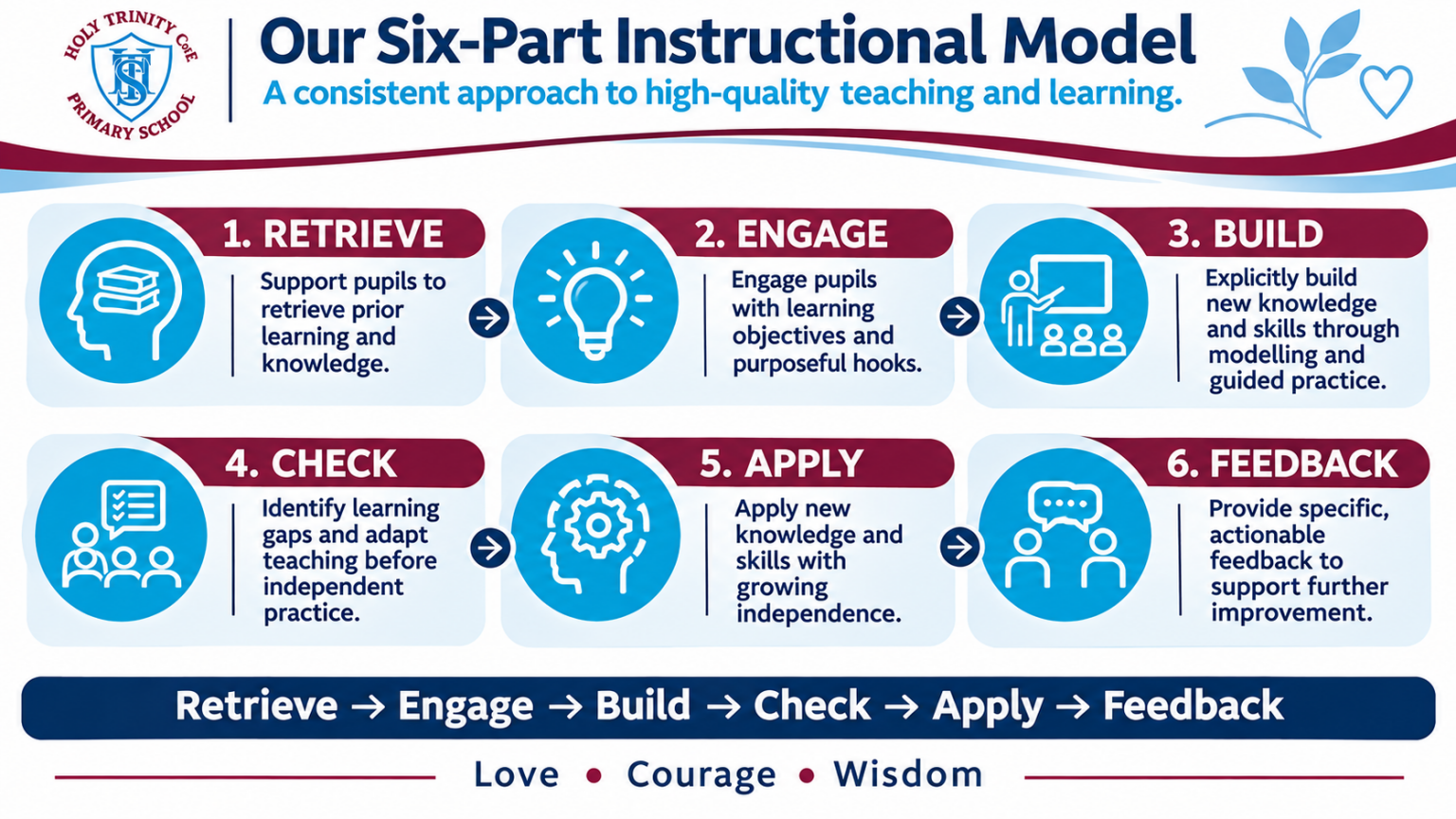
1. Retrieve – Remembering Previous Learning
Learning begins by connecting to what children already know.
Teachers provide regular opportunities for pupils to recall important knowledge, vocabulary and skills from previous lessons and topics.
Through short, purposeful retrieval activities, children strengthen their long-term memory and develop the foundations needed for new learning.
Retrieval may involve questions, quizzes, discussion or opportunities to recall information independently.
2. Engage – Establishing the Purpose of Learning
Children learn most effectively when they understand what they are learning and what success looks like.
Teachers establish clear learning intentions and success criteria, helping pupils understand the knowledge and skills they are expected to develop.
Where appropriate, purposeful activities or questions are used to generate curiosity, make connections and engage children in the learning.
Our focus is always on what children are learning, rather than simply the task they are completing.
3. Build – Explicit Teaching and Guided Practice
New knowledge and skills are taught explicitly through clear explanations, modelling and guided practice.
Teachers break complex learning into small, manageable steps, reducing unnecessary cognitive demands and helping children develop secure understanding.
This includes:
-
I do: The teacher demonstrates and explains new knowledge or skills, making their thinking visible.
-
We do: Children practise alongside the teacher, receiving guidance, questioning and feedback.
Teachers use worked examples, scaffolding and practical resources where appropriate, gradually reducing support as children's confidence and understanding develop.
This carefully structured teaching helps children build strong foundations before moving towards independence.
4. Check – Making Learning Visible
We recognise that understanding cannot be assumed.
Throughout lessons, teachers deliberately check what children know, understand and can do.
Through questioning, discussion, mini-whiteboards and other assessment strategies, teachers gather information about the learning of all pupils, not just those who volunteer answers.
This enables teachers to identify misconceptions, provide additional explanations and adapt their teaching in response.
Checking for understanding is particularly important before children move into independent practice. It helps ensure they have the knowledge and confidence needed to succeed.
5. Apply – Developing Independence
Once children have developed sufficient understanding, they are given opportunities to practise and apply their learning with increasing independence.
Teachers carefully select activities that help children consolidate knowledge, develop fluency and apply what they know in meaningful ways.
As children become more secure, the level of adult guidance is gradually reduced.
We believe that children should experience appropriate challenge, alongside the support needed to achieve success.
The aim is not simply for pupils to complete tasks, but to demonstrate understanding, deepen their learning and develop independence.
6. Feedback – Supporting Improvement
Feedback is an essential part of learning.
Teachers provide timely, specific and constructive feedback that helps children understand what they have achieved and what they need to improve.
Feedback may be given verbally or in writing, by teachers or through carefully structured peer discussion.
Importantly, children are encouraged to act upon feedback, correct misconceptions, refine their work and recognise their own progress.
Feedback happens throughout lessons, not just at the end, and helps teachers identify the next steps in learning.
Our instructional model is a flexible framework, not a rigid formula. Teachers adapt its use according to the subject, the age of the children and their learning needs. Checking for understanding and feedback are ongoing features of effective teaching.
Helping Children Remember More
We recognise that encountering information once does not mean it has been learned or remembered.
Our curriculum and teaching are deliberately designed to help children secure important knowledge in their long-term memory.
Teachers achieve this by carefully sequencing learning, activating prior knowledge and introducing new concepts in manageable steps.
Regular retrieval and deliberate practice provide opportunities for children to strengthen their understanding, whilst explicit vocabulary teaching ensures they develop the language needed to communicate and think effectively.
We also help children make meaningful connections between different areas of learning.
Our priority is depth of understanding, not simply the completion of activities or curriculum content.
Where children need additional explanations, practice or opportunities to revisit learning, teachers respond accordingly.
Ambition and Inclusion for Every Child
At Holy Trinity, we have high expectations for every child.
We believe that all pupils, including those with special educational needs and disabilities (SEND), disadvantaged pupils and children facing additional barriers, should have access to an ambitious and carefully sequenced curriculum.
Inclusion is fundamental to our approach to teaching.
Our teachers adapt how learning is presented, supported and practised without unnecessarily reducing expectations.
This may involve breaking learning into smaller steps, providing additional modelling, using visual or practical resources, offering scaffolds or adjusting the level of adult support.
Teachers work closely with support staff and our SENDCo to understand individual needs, identify barriers and ensure that appropriate adaptations are in place.
We are equally committed to developing independence. Support is carefully designed to help children participate successfully in learning, with scaffolds gradually removed as pupils become more confident.
Our ambition remains the same for every child: to experience success, develop confidence and achieve their potential.
Assessment That Makes a Difference
Assessment is an integral part of effective teaching at Holy Trinity.
We use assessment not simply to measure achievement, but to understand what children know, identify gaps and make informed decisions about what to teach next.
Assessment During Lessons
Teachers continually assess understanding through questioning, observation, discussion and children's work.
This allows them to respond immediately, adapting explanations, providing further modelling or offering additional support and challenge.
Understanding Progress Over Time
Teachers also use carefully planned assessments to evaluate how securely children have learned and remembered important knowledge and skills.
These include checks of prior knowledge, end-of-unit assessments and, where appropriate, standardised assessments.
Assessment information helps us identify pupils who need additional support, plan future teaching and evaluate the effectiveness of our curriculum.
We recognise that children's achievements cannot be captured by a single score. Teachers use a range of evidence and their professional knowledge to understand each child's progress.
Creating the Right Environment for Learning
We believe that children learn best in classrooms where they feel safe, valued and ready to learn.
Our learning environments are designed to be calm, purposeful, inclusive and supportive.
Clear routines and consistent expectations help children understand how to behave, participate and work successfully alongside others.
Classrooms are organised to reduce unnecessary distractions, whilst displays, resources and visual prompts are carefully chosen to support current learning.
We also recognise that some children require additional support with emotional regulation or sensory needs. Appropriate spaces and strategies help children regulate and return successfully to learning.
Our expectations of being Ready, Respectful and Safe, alongside our Christian values of Love, Courage and Wisdom, underpin the positive relationships and learning behaviours we promote throughout the school.
Continually Improving Our Teaching
We recognise that high-quality teaching requires ongoing professional learning, reflection and development.
Our teachers work collaboratively to share expertise, evaluate their practice and continually improve the learning experiences they provide.
We use evidence-informed professional development, including Teaching WalkThrus and instructional coaching, to help staff develop and refine effective classroom strategies.
Through focused professional dialogue, coaching and opportunities to learn from one another, we aim to ensure that every child benefits from consistently high-quality teaching.
Our approach is developmental, supportive and focused on what makes the greatest difference to pupils' learning.
Our Ambition for Every Learner
Ultimately, our aim is to help children become knowledgeable, curious, confident and increasingly independent learners.
We want pupils to develop secure foundations, communicate their understanding, embrace challenge and take pride in their achievements.
Through high-quality teaching, carefully sequenced learning and the right support, we prepare children for the next stage of their education and the opportunities and challenges beyond.
At Holy Trinity, we want every child to know more, remember more, do more and believe in their ability to succeed — enabling them to live life to the full.